 lilora
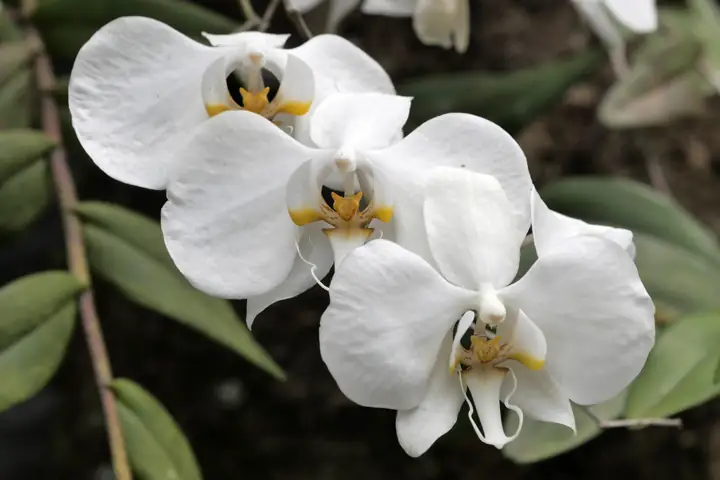
Moth orchids (Phalaenopsis) grow on trees in tropical and subtropical Asia and north-east Australia. Indoors they need bright indirect light, a bark-based orchid mix, watering that drains completely, warmth and good humidity. A cooler period helps many plants produce a new flower spike. The ASPCA lists them as non-toxic to cats and dogs. NC State Extension
Light
Give bright, indirect light. NC State suggests an east windowsill, or a well-shaded west or south window. The RHS advises bright light in winter to encourage flowering and keeping plants out of direct summer sun, which can scorch leaves. NC State Extension · RHS
Dark green, floppy leaves suggest too little light; yellowish or scorched leaves can mean too much. See the indoor light guide.
How to check before watering
Water when the bark is starting to dry. Roots that look silvery through a clear pot and a lighter pot are useful clues; green, plump roots have recently been watered. Water in the morning with tepid water, preferably rainwater, either from above or by standing the pot in a bowl, then drain thoroughly. Never leave it standing in water, and never let the roots dry out completely. NC State Extension · RHS
Mature plants may need water about weekly in the growing season and less in winter, but let the bark tell you. The watering guide explains why.
Potting mix and pot
Use a specially formulated, bark-based orchid mix. The RHS warns that loam-based or multipurpose compost will kill moth orchids. Repot every couple of years, or when the bark breaks down; healthy roots are plump, firm and silvery-white. RHS
Humidity and temperature
The RHS gives an ideal range of 19–30 °C (66–86 °F) by day and 16–19 °C (61–66 °F) at night, with a minimum of 16 °C (60 °F). Keep plants away from heaters and draughts. They prefer high humidity; a wide saucer of damp gravel under the pot helps. RHS
Feeding
Feed lightly and regularly in the growing season with an orchid fertilizer, watering without feed every fourth time to flush salts, and feed sparingly, if at all, in winter. RHS
Common problems
- No new flowers: NC State notes that many large-flowered hybrids need nights around 13 °C (55 °F) for about a week in autumn; the RHS suggests a spot about 5 °C cooler for a month.
- Bud drop: sudden changes in temperature, moisture or position.
- Shrivelled leaves: too little water, or roots damaged by soggy mix. Check the roots.
- Pests: mealybugs and scale.
Propagation
Home propagation is uncommon. Some plants form a small plantlet (keiki) on the flower stem, which can be potted once it has roots a few centimetres long.
After flowering, the RHS suggests cutting the old stalk just above the second node, or at the base if it has dried. RHS
Pets and people
The ASPCA Animal Poison Control Center lists Phalaenopsis orchids as non-toxic to cats and dogs, and NC State Extension tags them the same way. Non-toxic does not mean a pet can eat it freely: chewing can still upset a stomach, and treated or freshly fertilized plants carry other risks. If a pet seems unwell, contact a veterinarian. For people in Türkiye, the poison information line is 114 (UZEM). This is general information, not veterinary or medical advice.
Common questions
Should I water orchids with ice cubes?
The sources here recommend tepid water and thorough drainage instead.
Why are the roots growing out of the pot?
Aerial roots are normal for this epiphyte. Leave healthy ones in place.
Should I cut the stem after flowering?
Cut just above the second node, or at the base if the stem has turned pale and dry.